Active inference is a framework that integrates perception, action, and learning to minimize free energy, maintaining homeostasis in biological systems. It is versatile and theoretically robust but faces challenges in computational demand, implementation complexity, and empirical validation.
Active Inference: Overview, Functionality, Applications, and Limitations
Overview
Active inference is a theoretical framework that explains how biological systems, particularly the brain, maintain homeostasis by minimizing free energy. It integrates perception, action, and learning into a unified model, emphasizing the role of prediction and error minimization in cognitive processes.
How It Works
Active inference operates on the principle that agents maintain a model of the world and continuously update it based on sensory inputs. The framework involves:
- Generative Model: The agent maintains a probabilistic model of how sensory inputs are generated.
- Prediction: The agent predicts sensory inputs based on its model.
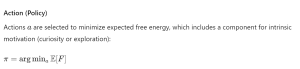
- Action: The agent takes actions to minimize the discrepancy between predicted and actual sensory inputs, thus minimizing free energy.
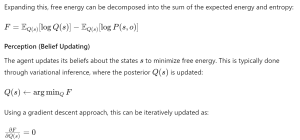
- Belief Updating: The agent updates its beliefs about the world to better match sensory inputs, using Bayesian inference.
The process can be summarized by the equation:
Free Energy=Prediction Error+Model Complexity
Where:
- Prediction Error is the difference between expected and actual sensory input.
- Model Complexity refers to the complexity of the agent’s internal model.
Mathematical Formulation
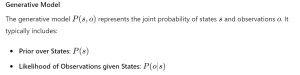
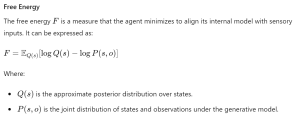
Active inference is a framework that combines Bayesian inference and the free energy principle to describe how agents (biological or artificial) interact with their environment. The mathematical formulation involves several key components: the generative model, the free energy function, and the update rules for perception and action.
Full Formulation
Combining these elements, the full formulation of active inference involves updating both the internal model (perception) and selecting actions (policy) to minimize free energy.
Math Summary
The mathematical foundation of active inference integrates the free energy principle with Bayesian updating and action selection, providing a comprehensive framework for understanding adaptive behavior in both biological and artificial systems. The key equations involve minimizing the free energy function through updates to beliefs and actions.
References:
- Karl Friston’s work on the Free Energy Principle.
- Variational methods and Bayesian inference in statistical learning.
- Applications in neuroscience, robotics, and AI for adaptive behavior.
Applications
Active inference is applied in various domains, including:
- Neuroscience: To model brain function and understand cognitive processes.
- Robotics: For adaptive control and autonomous decision-making.
- Psychiatry: To explain mental disorders in terms of dysfunctional predictive coding.
- Economics: For modeling decision-making and adaptive behavior in markets.
- Artificial Intelligence: In developing adaptive and intelligent systems.
Limitations
Active inference, despite its integrative approach, has several limitations:
- Computational Demand: Requires significant computational resources for real-time prediction and updating.
- Complexity of Implementation: Difficult to implement accurately due to the need for detailed generative models.
- Parameter Sensitivity: Performance can be highly sensitive to the choice of parameters in the generative model.
- Scalability: Challenges in scaling to complex, real-world environments.
- Empirical Validation: Limited empirical validation compared to more established frameworks like reinforcement learning.
Active inference provides a comprehensive framework for understanding and modeling adaptive behavior, with a strong theoretical basis in neuroscience and cognitive science.


