IC-Corp Bayesian Inference

Bayesian Inference
Bayesian inference is a probabilistic method for updating the likelihood of a hypothesis based on new evidence, combining prior knowledge with observed data. It is widely applicable but faces challenges in computational complexity, choice of priors, and data requirements.

Bayesian Inference: Overview, Functionality, Applications, and Limitations

Overview

Bayesian inference is a statistical method that applies Bayes’ theorem to update the probability of a hypothesis as more evidence or information becomes available. It provides a probabilistic approach to inference, allowing for the combination of prior knowledge with new data to make more informed decisions.

How It Works

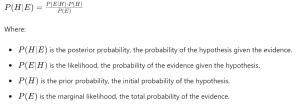
Bayesian inference updates the probability of a hypothesis HH given new evidence EE using the following formula:

Bayesian Inference Formula

Applications

Bayesian inference is used across various fields, including:

  1. Machine Learning: For model selection, parameter estimation, and predictive modeling.
  2. Medicine: In diagnostic procedures and personalized treatment plans.
  3. Finance: For risk assessment, portfolio optimization, and fraud detection.
  4. Engineering: In system reliability analysis and quality control.
  5. Environmental Science: For climate modeling and ecosystem assessment.

Limitations

Despite its robustness, Bayesian inference has several limitations:

  1. Computational Complexity: Calculating the posterior distribution can be computationally intensive, especially with large datasets or complex models.
  2. Choice of Priors: The results can be sensitive to the choice of prior distributions, which may introduce subjective bias.
  3. Data Requirements: Requires substantial amounts of data to accurately update the probabilities and make reliable inferences.
  4. Interpretability: Understanding and communicating Bayesian results can be more challenging compared to frequentist methods.
  5. Convergence Issues: In some cases, Markov Chain Monte Carlo (MCMC) methods used for approximation may have convergence problems, leading to inaccurate estimates.


Bayesian inference remains a powerful statistical tool, providing a comprehensive framework for incorporating prior knowledge and updating beliefs in light of new evidence.

Share the Post:

Related Posts

free energy principle active inference individual centricity 1TrueU

the Free Energy Principle

Revolutionizing Digital Security: Explore Karl Friston’s Free Energy Principle and its impact on neuroscience, psychology, AI, and more. Discover how IC-Corp’s 1TrueU leverages this concept for seamless protection and Individually centric personalized digital experiences.

Read More
Random Forest Learning

IC-Corp Random Forest Learning

Random Forest Learning is an ensemble method that constructs multiple decision trees using random subsets of data and features, aggregating their predictions for improved accuracy and robustness. It is widely used but faces challenges in computational cost, interpretability, and the need for careful parameter tuning.

Read More

Copyright © 2026 Individual Centricity Corporation – All Right Reserved