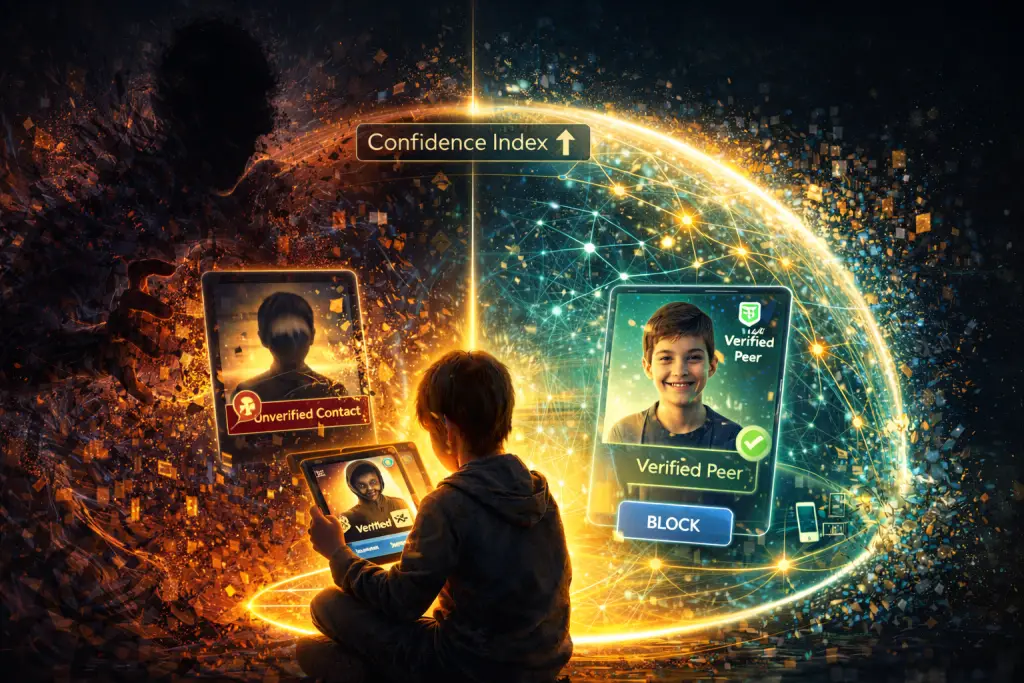
For twenty years, platforms have tried to keep bad actors out the same way: build a wall, check IDs at the gate, and hire an army to watch what happens inside.
It hasn’t worked.
Social media now spends $12–20B a year on content moderation, employs 100,000+ people, and runs the most advanced AI detection systems ever built. And yet: 546,000 children were targeted by online predators last year (up 192% year-over-year). AI-generated exploitation material is up 6,343%. One platform reported 528,000 “inappropriate interactions with children” in a single quarter.
The walls keep getting higher. The problem keeps getting worse.
The problem isn’t detection. It’s identity. You can’t solve a people problem by policing content. Predators don’t stop because they get caught—they stop when they can’t come back. Today, a ban is a five-minute inconvenience: new email, new account, clean slate. The person walks free; only the account disappears.
Content moderation treats symptoms. Identity treats the disease.
One person. One identity. Everywhere. 1TrueU is built on a simple premise: what if a ban followed the person, not the account?
We use continuous behavioral biometrics—how you type, swipe, and hold your device—to establish an identity that can’t be faked, transferred, or abandoned. An adult can’t mimic how a 12-year-old uses a phone. A predator can’t shed their history by switching platforms. And because processing stays on the device, there’s no centralized identity database to breach—privacy is preserved by architecture.
We don’t replace the law. We make it work.
KOSA. The TAKE IT DOWN Act. COPPA 2.0. The EU Digital Services Act. Laws can mandate action, but they can’t make a banned person stay banned. 1TrueU is the missing enforcement layer—technology that makes regulation real.
The technology behind 1TrueU™ isn’t incremental. It’s architectural. Here’s what makes it work:
IC-Corp’s 1TrueU uses behavioral biometrics—how you type, swipe, hold a device, move a mouse, and interact over time—to recognize you in a way that’s hard to fake and easy to live with. Instead of relying on a single “check” (like a password), 1TrueU continuously builds confidence from natural interaction signals.
The benefit is simple: you don’t have to “prove yourself” all day. When your behavior matches your normal patterns, your experience stays smooth. When something deviates, 1TrueU can quietly raise scrutiny (or request a minimal booster) before damage is done—supporting Frictionless Existence™ without compromising security.
Deepfakes succeed when systems trust static proof (a photo, a face scan, a recorded voice) without verifying whether the evidence is alive, local, and consistent over time. 1TrueU is designed to resist that trap by relying on multi-signal continuity and on-device validation rather than one-off “presentation” checks.
Because identity confidence is built from ongoing, real-world interaction patterns and can be reinforced by local “challenge-response” style boosters when needed, attackers face a moving target. The outcome is far fewer ways to spoof you, especially when a fake video or synthetic voice tries to pass as a real person.
Most security systems create friction because they interrupt you at the worst moments—password resets, MFA prompts, lockouts, “verify your identity” loops. 1TrueU flips the model: it’s designed to stay out of your way when risk is low, using passive signals and local inference to keep confidence high.
When risk rises, the system predictively selects the least disruptive step—often a lightweight booster rather than a full stop. The practical benefit is less interruption and fewer dead ends, while still raising security precisely when it matters.
Traditional authentication is a “front door” check: once you’re in, the system assumes you remain the same trusted user. 1TrueU uses a Confidence Index (CI) that updates continuously, so identity assurance is maintained throughout the session—especially important for high-value actions like payments, sensitive data access, or admin controls.
For everyday users, this means security follows the action, not a single login moment. If something changes—device behavior, interaction patterns, environmental consistency—the CI reflects that quickly, enabling graceful step-up protection before fraud or takeover succeeds.
With 1TrueU, the intelligence runs at the edge—on your device—where your signals originate. That aligns with IC-Corp’s Individually Centric Fractal Architecture (ICFA): each user (and device) forms a local trust center, bounded by a “Markov blanket” security boundary that minimizes unnecessary data exposure.
The common-man benefit: your data doesn’t have to travel to be useful. Decisions can be made locally, faster, more privately, and with fewer failure points—while still enabling secure interactions across your devices.
Centralized identity systems often create “honeypots”—large databases of credentials, biometrics, tokens, or identity proofs that attackers can steal in bulk. IC-Corp reduces that risk by designing 1TrueU to operate with minimal centralized storage, focusing on local inference and point-to-point trust rather than warehouse-style identity.
In plain terms: there’s less to steal, and less damage if breached. By avoiding the “one vault with everything” model, the system reduces catastrophic, large-scale compromise scenarios that have become routine in enterprise-centric identity.
1TrueU is built to fit into real environments—apps, browsers, endpoints, and enterprise policy stacks—without forcing a rip-and-replace identity overhaul. The CI becomes a flexible trust signal that can map to “minimum confidence required” for different actions (view, edit, transfer funds, admin access), while the user can always tighten thresholds for personal security.
The benefit is security that plugs in without breaking workflows. Organizations can improve assurance and reduce fraud without turning every login into a customer-support event.
IC-Corp’s Privacy-by-Architecture means 1TrueU is built so privacy isn’t a “setting” or a policy promise—it’s a structural property of the system. Identity confidence is generated at the edge, inside the user’s own Markov blanket boundary, using locally observed signals and minimal disclosure by default; when anything must be shared, it’s shared point-to-point and purpose-limited rather than collected into centralized repositories. The result is practical data sovereignty: fewer exposed artifacts, reduced correlation across services, no identity “honeypots,” and a Frictionless Existence™ experience where stronger security doesn’t require giving up control of your personal data.
ICFA is “fractal” in the practical sense: the same trust logic works at multiple levels—within a single device, across a user’s device cluster, and through broader ecosystems—without requiring centralized control. This structure supports growth while keeping decision-making close to where truth is observable: the user’s interactions and outcomes.
The benefit is security that scales without becoming brittle. As users add devices, roles, and use-cases, the system can expand naturally—maintaining privacy, responsiveness, and resilience instead of turning into a complex, fragile identity stack.
IC-Corp’s ICFA strengthens ethics and governance by making user autonomy and data sovereignty enforceable by design, not by policy. With identity inference and control at the edge—inside each individual’s Markov blanket boundary—ICFA minimizes data collection and avoids centralized “honeypots,” limiting breach impact. Governance is clearer because trust is expressed as a measurable Confidence Index tied to specific actions, enabling proportional, least-intrusive step-up protections—supporting Frictionless Existence™ with accountability built-in.
Copyright © 2026 Individual Centricity Corporation – All Right Reserved